What happens when you stop taking finasteride?
When you stop taking finasteride, hair loss returns on a schedule, within 9 to 12 months. Side effects follow none, and have barely been studied.
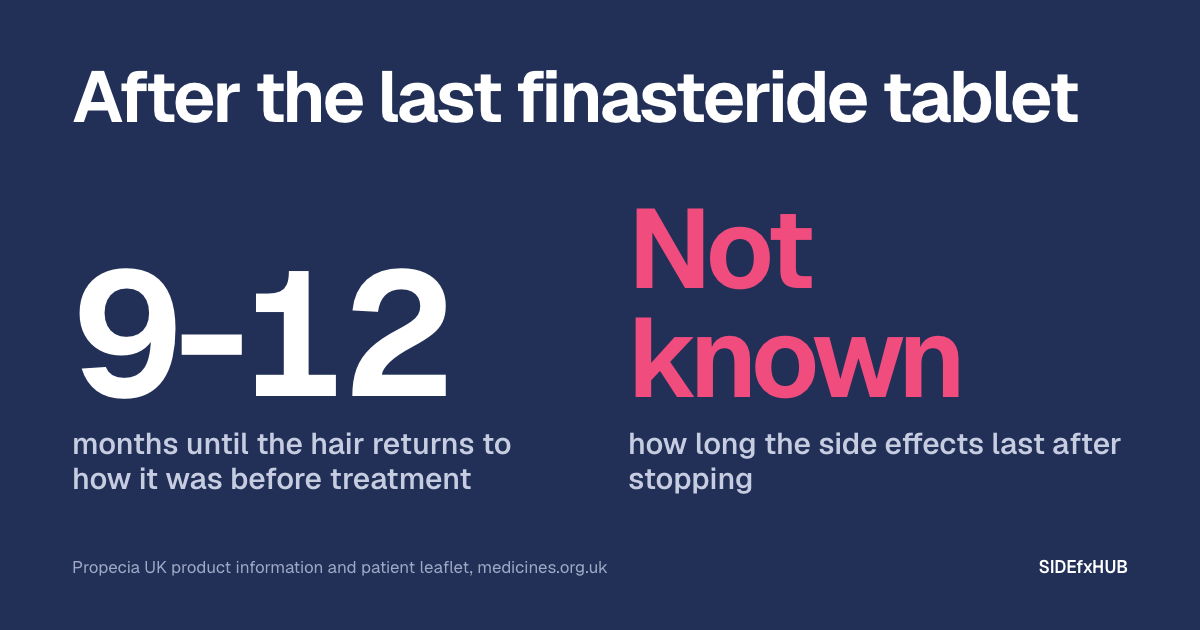
When you stop taking finasteride, hair loss comes back on a schedule. The UK leaflet says hair gained on it is likely to be lost within 9 to 12 months. Side effects follow no schedule at all. For some people they clear. For others they continue, or get worse after stopping, and nobody can tell you in advance which group you will be in.
That difference reflects what was studied, not how the leaflet is worded. What finasteride does for your hair after the last tablet has been measured, almost to the month. What happens to its side effects after the last tablet has barely been studied. If you have stopped and are still waiting for things to return to normal, this is what is known and where it runs out.
What happens to your hair and hormones
The drug leaves your body quickly. Finasteride has a half-life of 5 to 6 hours in men aged 18 to 60, which means the amount in your blood halves every 5 to 6 hours. In men over 70 it is about 8 hours.
Finasteride works by lowering DHT, a hormone your body makes from testosterone. The US label for the 5 mg tablet gives one measurement of how fast DHT recovers: healthy men who took it for 14 days had DHT back to its level before treatment in about 2 weeks. No label gives a figure for the 1 mg hair-loss dose, or for someone who took it for years.
The hair itself changes over months. The UK prescribing information says the benefit begins to reverse by six months and is back to where it started by 9 to 12 months. The US trials checked this directly. Forty-eight men were switched to a dummy tablet after a year on finasteride and followed for another twelve months, by which time the hair they had gained was gone.
After the last finasteride tablet
Do finasteride side effects go away after stopping?
For some people they do, and for some they do not. In the trials of the 1 mg dose, sexual side effects cleared in the men who stopped because of them, and in most of those who kept taking it. Neither the UK nor the US product information says how long that took. So if you read that side effects clear “within two weeks”, that figure is not from the label.
The trials that tracked hair so carefully have much less to say here. Clinical trials do not routinely include follow-up to check that sexual side effects have gone, as the authors of the 2022 diagnostic criteria for these conditions point out. The benefit was followed for a year after stopping. The labels report no similar follow-up for side effects.
That side effects can last is no longer in dispute on paper. The US label lists sexual problems that continued after discontinuation. The UK leaflet names erection, sex drive and ejaculation problems that persisted after stopping. In 2024 the MHRA, the UK medicines regulator, noted reports that sexual dysfunction has persisted even after treatment was stopped. The NHS says side effects can sometimes carry on even after you stop. What none of them says is how often, or for how long.
When side effects last
Patients and researchers call it post-finasteride syndrome, or PFS. The 2022 diagnostic criteria, a consensus of 37 researchers built on case reports, count a problem still there 3 months after stopping as supporting the diagnosis rather than as a requirement. Sexual problems that clear after stopping are not PFS.
The best-known figures on how long it lasts come from two small studies at George Washington University in the US, and they need reading carefully. Both recruited only men whose side effects had already lasted at least 3 months.
- In a 2011 study of 71 men, symptoms had lasted 40 months on average, counted from stopping to the interview.
- In a 2012 study, 54 of those men were assessed again 9 to 16 months later, and 96% still had persistent sexual side effects.
Because the men were chosen for having lasting symptoms, these numbers describe what happens to people who already have PFS. They cannot tell you your own odds, and they cannot show how many people who stop finasteride recover. That question, the 2022 criteria say, “has never been properly investigated”.
Lasting side effects can reach mood as well. In a 2012 study of 61 former users with lasting sexual side effects, 46 had symptoms of depression, compared with 3 of 29 men with hair loss who had never taken finasteride. It is a small study of men chosen because they already had lasting side effects, so it shows a pattern worth taking seriously, not a rate.
Alex, a pharmacy student, knows the side of the story the trials did not follow. In a 39-minute interview with the Moral Medicine channel, he describes the sexual, physical and neurological side effects that continued after he stopped.

Side effects that start after stopping
Side effects can start after stopping, according to the 2022 diagnostic criteria, which cover finasteride, some antidepressants and isotretinoin together. They say a lasting sexual problem may appear only once the drug is stopped, or a mild one may get worse, and add that data on when symptoms start are limited.
The finasteride product information does not describe this. The regulator has noticed it all the same. In its 2024 safety update, the MHRA asked people reporting side effects to say whether a side effect “continued or started after treatment was stopped”. In patient communities, symptoms that start or suddenly get worse after stopping are often called a “crash”. If that has happened to you, tell your doctor, and include it in any report you make.
No study on tapering, and what to do now
Nobody knows whether tapering finasteride, rather than stopping at once, changes anything. We searched the medical literature and found no study that compares the two, and neither the UK prescribing information nor the US label gives a tapering schedule. You will find confident advice online in both directions. Without a study, neither side can show it is right.
Do not stop or change a medicine because of anything on this page.
Whether to stop finasteride, and how, is a decision for you and your prescriber. One exception is written into the UK leaflet itself: if you take the 1 mg dose and develop depression or suicidal thoughts, it says to stop taking it and contact your doctor as soon as possible.
Talk to a doctor whenever sexual side effects bother you, whether you still take finasteride or have stopped. Low mood needs attention too: the European Medicines Agency’s 2025 review confirmed suicidal thoughts as a side effect of finasteride tablets. For low mood, the NHS says to call your doctor or 111. If you have thoughts of harming yourself, it says to call 999 or go to A&E now.
Your doctor may not have come across these warnings, so bring them with you:
- The leaflet or patient card from the pack. The leaflet lists the side effects that can continue.
- Your dose, and roughly when you started and stopped.
- What changed, and when. Say whether it started or continued after stopping.
- Any change in mood, even if it seems unrelated.
Our guide on how to approach your doctor about PFS has more on that conversation. You can also report it yourself, without a doctor: a Yellow Card report tells the UK regulator about one reaction.
MedDRA code 10082430
English term: Post 5-alpha-reductase inhibitor syndrome
Use it if you took finasteride or dutasteride and the side effects continued after stopping. Write the exact wording in the free-text box, then describe your symptoms in your own words. Our reporting guide covers the UK and other countries.
The label can tell you almost to the month when the hair will go. It cannot tell you when, or whether, the side effects will. Until someone studies what happens after the last tablet, the most useful record is the one you keep yourself: for your doctor, in a report, and in the patient community. The community follows people over months and years, which a single report cannot.
If you are struggling with your mental health, the Samaritans are on 116 123 in the UK, free, at any hour. In the US, call or text 988.
This information does not replace medical advice. Talk to your doctor before you make any decision about your treatment.
580+ people have joined the community.
Join them, then report your side effects.
- Put your condition on the record
- Be first to hear about studies you can join
- Then report your side effects to your regulator