Topical finasteride: is it safer than the pill?
Topical finasteride puts less of the drug in your blood, not none. Whether that makes it safer, with fewer side effects that last, has not been measured.
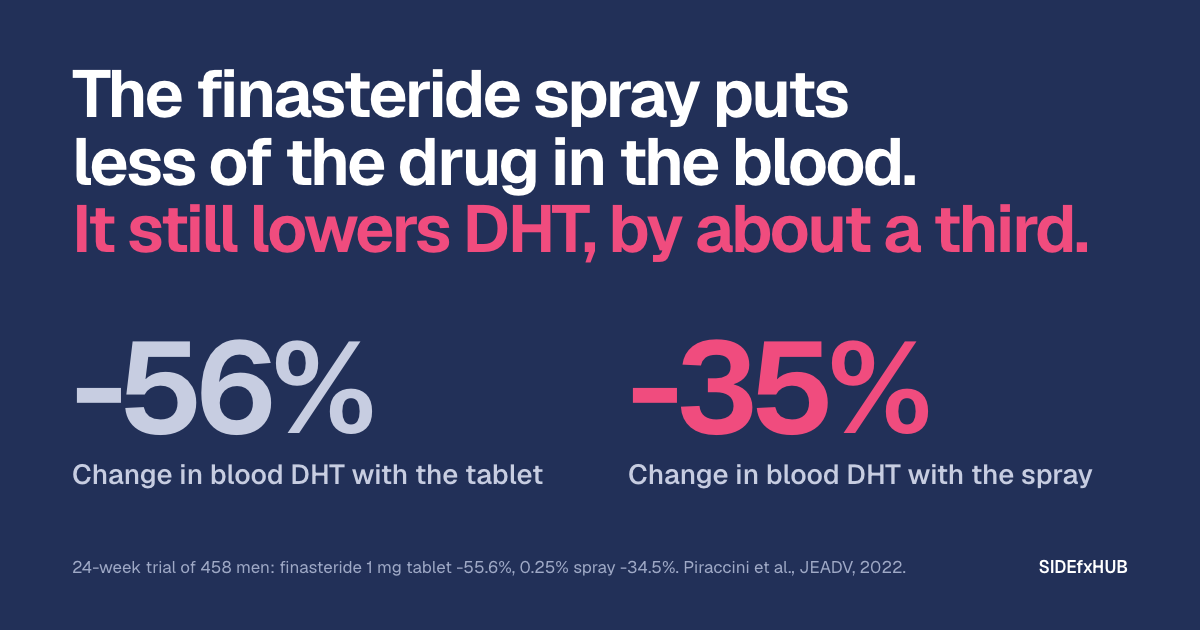
Topical finasteride puts much less of the drug into your blood than a tablet, which is why you may have been told it is safer. Whether less in the blood means fewer side effects that last after stopping has not been measured. And less is not none. In a 24-week trial, a finasteride spray still cut DHT, the hormone the drug lowers, by about a third in the blood.
“Safer” is a claim about exposure: how much drug reaches your body. What matters to you is whether side effects happen, and whether they last. No study we could find has followed a group of spray users for more than four weeks after stopping. Until one does, “safer” rests on blood tests and short-term studies.
Less finasteride in the blood, but not none
A spray is meant to act on the scalp, where finasteride blocks the step that turns testosterone into DHT. But the US Food and Drug Administration (FDA) says absorption through the skin “into the bloodstream is expected”.
A trial of 458 men in Europe measured how much gets through. Over 24 weeks it compared a 0.25% spray with the 1 mg tablet and a placebo, and the companies developing the spray paid for it, as is normal for a new medicine. Peak finasteride levels in the blood were more than 100 times lower with the spray. Yet blood DHT still fell by 34.5%, against 55.6% on the tablet and no change on placebo.
The spray still lowers DHT in the blood
The trial’s authors concluded that there is “less likelihood” of sexual side effects linked to lower DHT. That is the strongest argument for calling the spray safer. The European Medicines Agency (EMA) agrees that exposure is “markedly lower”, but its 2025 assessment report adds that this “does not completely exclude the risk” of side effects elsewhere in the body.
At lower doses the fall is smaller, but it does not disappear. In a one-week study of 32 men using the same solution, the two smallest doses still cut blood DHT by 24% and 26%, though the study measured hormones, not side effects.
Is topical finasteride safer? What the studies did not measure
In the same trial, treatment-related sexual side effects were reported by 2.8% of men on the spray, 3.3% on placebo and 4.8% on the tablet, and scores on a sexual function questionnaire did not differ significantly between spray and placebo.
That is five men on the spray, six on placebo and four on the tablet. The trial was sized to show whether the spray grew hair, not to compare side effects. Its last visit came four weeks after treatment ended, too soon to show whether any problem lasted for months.
The largest study asked even less. Written by staff and advisers of a US telehealth company, it included 638,629 men prescribed a pharmacy-mixed finasteride and minoxidil product. About 130 days in, people were asked one yes-or-no question about being “bothered by any side effects”. Only 23.7% answered, 2.7% of them said yes, and everyone who answered was still in treatment.
A study that followed spray users for a year or more after stopping would show whether a lower blood level means fewer problems that last. We could not find one.
Topical finasteride side effects that continued after stopping
In April 2025 the FDA warned about compounded topical finasteride, meaning products mixed by a pharmacist or doctor for one patient. It had 32 reports from 2019 to 2024, including erectile dysfunction, low libido, depression, suicidal thoughts and brain fog. Most said the problems “continued to persist after product discontinuation”. Some said a prescriber had told them “there was no risk of any adverse event because the product was topical”.
Thirty-two is a count, not a rate. The FDA says reports cannot be used to estimate how often something happens, and a report does not mean the drug caused it. A 2025 analysis of the FDA’s reports found fewer warning signals for topical finasteride than for tablets, but not none, and it cannot give a rate either.
Sawyer used topical finasteride for three months, and his story describes effects that continued after he stopped. One account cannot show how often that happens, only what it is like.

The EMA’s 2025 review confirmed suicidal thoughts as a side effect of finasteride tablets. For sprays, it found “no evidence linking suicidal ideation”. The assessment report shows what that rests on: the review found no relevant study, and no report from someone using only a spray was judged a possible or probable case. In our view, that is an absence of evidence, not evidence of safety: reports cannot give a rate, and neither can their absence.
The EMA’s safety committee judged that the sprays’ balance of benefits and risks “remains favourable”, and noted that their product information already warns about the mood changes seen with tablets, including suicidal thoughts. It also asked the licence holders to review the risk again. The committee noted that no suicide-related events were reported in the sprays’ clinical trials, but the same was true of the tablet trials, and suicidal thoughts were still confirmed as a side effect of the tablets.
If any of this is close to home, the Samaritans are on 116 123 in the UK, free, at any hour. In the US, call or text 988.
Do not stop or change a medicine because of anything on this page.
If you use a finasteride spray or tablets and something has changed, tell the person who prescribed it and decide the next step together. If your mood has dropped or you have thoughts of suicide, speak to a doctor as soon as you can.
Rules written for tablets
Finasteride’s safety measures were built around the tablet. In the US, where no finasteride product for the skin is approved, the FDA does not review compounded drugs for safety, effectiveness or quality before they are sold. In the EU, sprays have been licensed since 2020, but the new patient card goes into packs of 1 mg tablets. In the UK we could find no licensed finasteride spray: the UK medicines compendium lists only tablets, so a spray offered here is likely to be unlicensed or made up by a pharmacy, and it is worth asking which. The Medicines and Healthcare products Regulatory Agency (MHRA) describes finasteride in its 2024 review as “a film-coated tablet”, and its safety updates of April 2024 and May 2026 do not mention sprays.
The spray you are offered may not be the one studied, either: the trial used 0.25% finasteride alone, while the telehealth company prescribed 0.3% with 6% minoxidil.
We think this is where “safer” is checked least. The patient cards and the UK’s safety updates were written for the tablet, and in the US no finasteride spray has been approved, while compounded ones are not reviewed before they are sold.
If a partner is or could become pregnant
Finasteride must not be used during pregnancy, because it may cause abnormalities in a male baby. Women are told not to handle crushed or broken tablets for that reason, and the coating on a whole tablet prevents contact in normal handling. Finasteride on your scalp has no coating. The FDA says topical finasteride carries a “greater potential risk for inadvertent exposure to others, specifically females, through transfer of applied product”, and asks prescribers to explain it. If your partner is or could become pregnant, ask your prescriber how to avoid passing it on.
Before you start, and if something has changed
If you are deciding, ask the prescriber:
- Is this a licensed product, or mixed by a pharmacy?
- How much finasteride will I apply each day, and what else is in it?
- Can side effects continue after stopping? Some people who reported to the FDA said they had been told there was no risk because the product was topical.
- Who do I contact if my sex drive, erections or mood change?
- How do I avoid exposing a partner who is or could become pregnant?
If something has changed, tell the person who prescribed it, and report it through the MHRA’s Yellow Card scheme in the UK or the FDA’s MedWatch in the US, saying you used it on your scalp. What happens when you stop taking finasteride sets out what the labels say about symptoms that continue.
A report records one reaction on one day. The SIDEfxHUB Community records how things change over months and years, which a one-off report cannot.
MedDRA code 10082430
English term: Post 5-alpha-reductase inhibitor syndrome
MedDRA is the medical dictionary regulators use to code reports. Use this term if symptoms continued after topical finasteride, finasteride tablets or dutasteride. Write it in the free-text box, then describe what happened. Our reporting guide covers the UK, the US and other countries.
The case for the spray rests on a blood test. Nobody has yet followed spray users long enough after stopping to show whether a lower level means less harm that lasts, so for now “safer” is an assumption, not a finding. If you use one and something changes, tell your prescriber, report it, and add it to the community, which follows people after they stop.
If you are struggling with your mental health, the Samaritans are on 116 123 in the UK, free, at any hour. In the US, call or text 988.
This information does not replace medical advice. Talk to your doctor before you make any decision about your treatment.
580+ people have joined the community.
Join them, then report your side effects.
- Put your condition on the record
- Be first to hear about studies you can join
- Then report your side effects to your regulator