Finasteride warnings: MHRA, EMA and FDA
Regulators have updated finasteride's safety warnings at least seven times since 2011. It is not banned, and none can say how often the harm lasts.
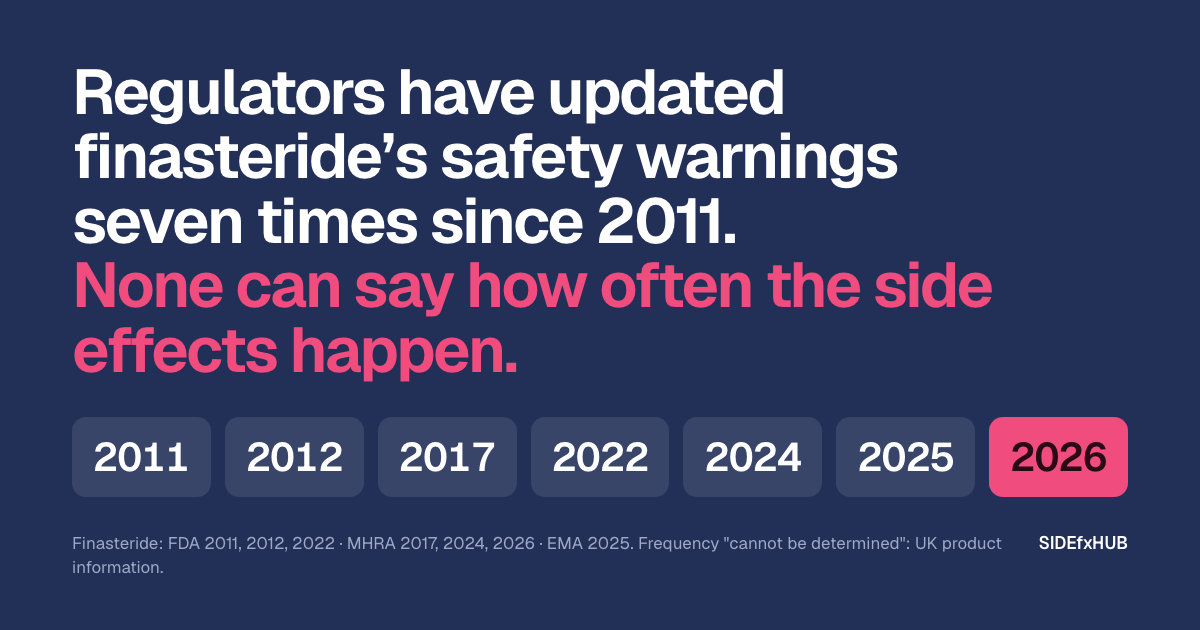
Finasteride is not banned in the UK, the EU or the US. What has changed is the warning that comes with it. Since 2011, medicines regulators have updated it at least seven times, most recently in the UK on 11 May 2026. Yet none of them can tell you how often the side effects last after stopping, or how often suicidal thoughts occur.
That gap matters more than any single warning. When the UK regulator reviewed finasteride in 2023, the side effects were already on the label. The review was started by something else: patients telling the regulator that doctors, and the people taking finasteride, did not know about them. A warning protects nobody who never hears it.
What do the finasteride warnings say now?
Three regulators decide what a finasteride pack must tell you. In the UK it is the MHRA, the Medicines and Healthcare products Regulatory Agency. In the EU it is the European Medicines Agency (EMA), and in the US the Food and Drug Administration (FDA). Over fifteen years, all three have moved in the same direction.
Seven of the updates to finasteride's safety information
The current UK advice to doctors is plain. Finasteride “is associated with depression, suicidal ideation and sexual dysfunction which may persist after treatment is stopped”, the MHRA wrote in May 2026. Doctors are told to explain these risks when they prescribe, and to ask about any history of depression first.
The EU reached a similar place in 2025. Its safety committee confirmed suicidal thoughts as a side effect of finasteride tablets, after finding 325 relevant cases in the European reports database. The same review found no such evidence for finasteride sprays, which our page on topical finasteride covers. It also concluded that the benefits of finasteride and dutasteride “continue to outweigh their risks for all approved uses”. That is the regulators’ position, and it is why the medicine is still sold.
In the US, the current Propecia label lists sexual problems that continued after treatment stopped, and depression, suicidal thoughts and behaviour, among side effects reported after approval. It carries no boxed warning, which is the FDA’s strongest kind and is sometimes called a “black box”.
Do not stop or change a medicine because of anything on this page.
One exception is written into the regulator's own advice. The MHRA says people taking finasteride 1 mg should stop it if they develop depression or suicidal thoughts, and contact their doctor. On finasteride 5 mg or dutasteride, the advice is to contact a doctor as soon as possible.
Seven updates, and still no number
Every update on that list rests on reports of harm. None rests on a measurement of how often that harm happens. The UK product information does give a frequency for some side effects while people take finasteride: lower sex drive and depression are “uncommon”, up to 1 in 100. For the harms these updates are about, sexual problems that last after stopping and suicidal thoughts, it gives none.
The EMA says the frequency of suicidal thoughts with finasteride cannot be estimated from the data. The UK product information says the frequency of reactions reported after approval “cannot be determined”. When the FDA widened the label in 2012, it wrote that clear causal links had “NOT been established”. In the same statement it said the cases suggested “a broader range of adverse effects than previously reported”.
There is a reason the number is missing, and it is built into the system. A side effect report shows that something happened to someone. It cannot show how many people took the drug without a problem, so it can never give a rate. For the hair-loss dose, even the regulator does not know how many people take it. It is not prescribed on the NHS, and the MHRA’s own review says the number of users is hard to know.
The trials that led to approval cannot fill the gap. The labels say sexual side effects resolved in the men who stopped because of them, but not how long those men were followed. And trials of this kind do not routinely check that sexual side effects have gone, which is exactly the question that matters here.
So if anyone tells you the risk is tiny, or that it is huge, ask where the figure came from. No regulator has published one.
Reports cannot give a rate, but the regulator does count them. By 31 May 2025 the MHRA had received 170 reports of suicidal thoughts with finasteride, and 19 reports of death by suicide. The MHRA adds that a report “does not necessarily mean that the medicine has caused the reaction”. If any of this is close to home, the Samaritans are on 116 123 in the UK, free, at any hour. In the US, call or text 988.
A card in the box, a pill bought online
In April 2012 the FDA wrote that prescribers and patients “need to be aware” of these side effects. More than a decade later, the UK regulator reviewed finasteride because patients said that awareness was still missing. They had told the MHRA they were concerned about “the apparent lack of awareness among health care professionals and patients”. Its review, published in 2024, agreed that more could be done.
The answer was a patient card in every pack. It is a real step, and it has a limit built in: a card inside the box reaches you after the decision to take the medicine has been made.
That decision now often happens online. Finasteride 1 mg for hair loss is not available on the NHS, so people get it from private clinics or, more often, from online pharmacies. The MHRA met some of those pharmacies. Some, it found, “have thorough screening and monitoring processes in place, others do not”. Regulating them “is not within the remit of the MHRA”. That job belongs to the General Pharmaceutical Council, which told pharmacies in October 2024 that “providing finasteride at a distance carries particular risk”.
We think this is where the warnings are weakest. The advice to doctors assumes a prescriber who asks about your history and keeps an eye on your mood. The MHRA’s review accepts that buying online is a route which “does not easily allow them to be monitored” for exactly those side effects.
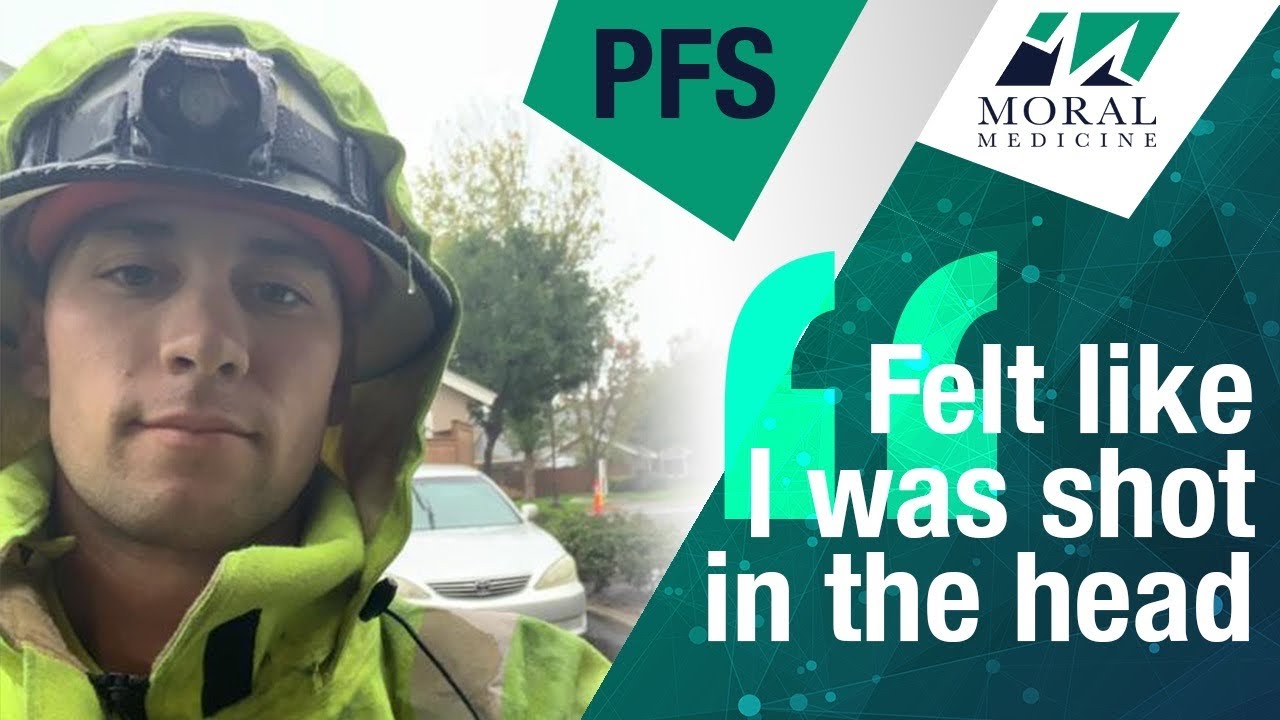
Miles took finasteride for hair loss and never thought the side effects would happen to him. In a 31-minute interview with Moral Medicine he describes the ones that continued after he stopped. His story has its own page.
What can you do if it has already happened to you?
The warnings are not a diagnosis. Patients asked the MHRA to recognise post-finasteride syndrome as a medical condition, and its answer was that this is not within its remit. But they are official documents, and you can put them on a doctor’s desk.
- Take the card and the leaflet to your prescriber. The MHRA introduced the card because prescribers may not know these side effects. Our page on what happens when you stop taking finasteride sets out what the labels say about symptoms that continue.
- Report it. In the UK that is the Yellow Card scheme, and in the US it is MedWatch. You do not need a doctor to agree with you, and you do not need proof.
- Join the patient community. A report records one reaction on one day. The community follows people over months and years, which is the record the regulators’ own databases were never built to keep.
MedDRA code 10082430
English term: Post 5-alpha-reductase inhibitor syndrome
Use it if you took finasteride or dutasteride and the side effects continued after you stopped. Write that exact wording in the free-text box, then describe your symptoms in your own words. “Post-Finasteride Syndrome” is the patients' name for it and is not in the dictionary. Our reporting guide covers the UK, the US and other countries.
The warnings now say what patients reported for years: finasteride’s side effects can outlast the tablets. What they still cannot say is how often, and only a study that follows people after they stop could answer that. Until one exists, the record of what happens next is the one patients make themselves, in a report and in the community.
If you are struggling with your mental health, the Samaritans are on 116 123 in the UK, free, at any hour. In the US, call or text 988. The mood side of this is covered in our page on Propecia, depression and suicide.
This information does not replace medical advice. Talk to your doctor before you make any decision about your treatment.
580+ people have joined the community.
Join them, then report your side effects.
- Put your condition on the record
- Be first to hear about studies you can join
- Then report your side effects to your regulator